
Sourced history
A school for a decentralized company
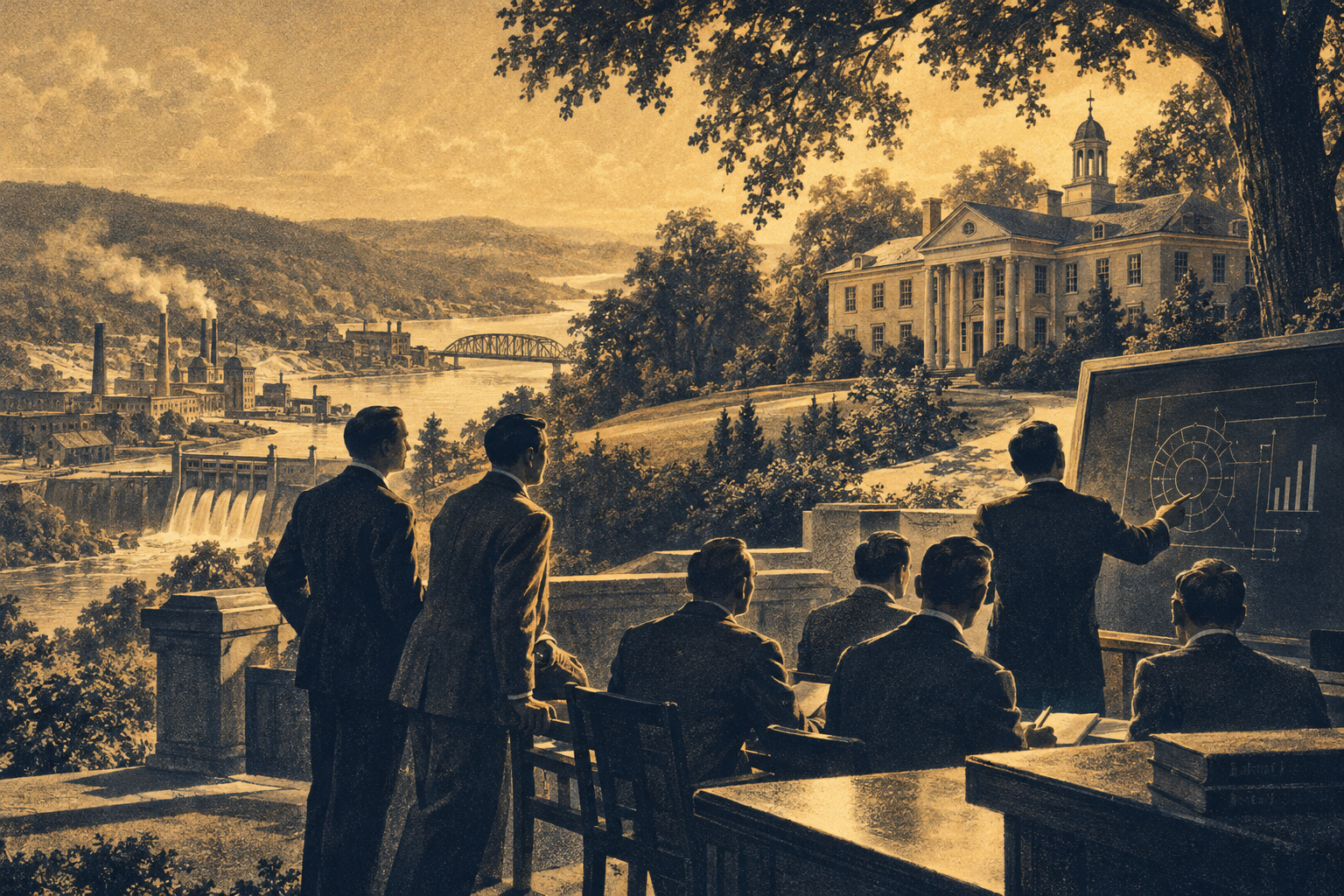
GE established its corporate university at Crotonville, New York, in 1956. Ralph Cordiner inaugurated it to prepare general managers for a broad decentralization program. Among the earliest corporate universities in the world, Crotonville subsequently gained recognition as an innovator and a model for leadership development. A GE News retrospective described an ambitious original goal: making GE the world’s best-managed company. Its advanced managers’ course lasted 12 weeks, with instruction directed toward responsibilities such as expanding manufacturing processes. Leadership education was therefore tied to the practical demands of managing the business.
Sourced history
Learning as an instrument of change
Beginning in the 1980s, Crotonville became a central base for CEO Jack Welch’s campaign to change GE’s culture. Programs emerging from that effort included Work-Out, intended to reduce bureaucracy and restore initiative to individual managers. The IMD account traces Crotonville’s development across successive GE leaders, from Cordiner to Jeffrey Immelt. It examines how the institution adapted to changing business requirements, rather than treating its leadership curriculum as something fixed. Under Welch, that relationship between education and organizational change became especially prominent.
Sources: [1]
Sourced history
Reimagining a familiar institution
After the global financial crisis of 2008–9, Immelt and Crotonville’s leaders began exploring what leadership required in GE’s altered global operating environment. Susan Peters launched Re-Imagining Crotonville to bring learning and development into alignment with those expectations. The questions extended beyond course content to the learning environment and the experience of attending Crotonville. IMD’s 2012 case study, covering the institution’s history through 2010, also framed a central challenge: how to keep evolving while retaining the distinctive qualities and reputation built through earlier success.
Sources: [1]
Sourced history
Opening the classroom to customers
By the time of Jane Nicholls’s October 2017 GE News report, Crotonville’s mission included developing and connecting leaders beyond GE itself. Twice annually, its Global Customer Summit brought together around 300 customers for five days of learning and networking. Participants stayed in campus residences and attended sessions spanning neuroscience, emerging technologies, additive manufacturing and leadership. The September 2017 gathering included customers from Qantas, Jetstar and Nova Energy. Speakers included New York University professor David Yermack on blockchain and GE Additive’s Christopher Schuppe on design and manufacturing. An extended session with newly appointed CEO John Flannery concluded the program described in the report.
Sources: [2]
Sourced history
A sale and a debate about learning
Writing on May 3, 2024, McChrystal Group’s David Livingston and Ryan Flynn reported that GE had announced the sale of its Crotonville leadership development center. They used the development to argue for more targeted, digitally supported leadership education. Their proposed alternative was not exclusively online. They recommended combining accessible digital resources with interactive learning events and time for colleagues to connect. This was their interpretation of the implications for leadership development, rather than a stated explanation from GE for the sale.
Sources: [4]
Connection to GE's wider history
Connecting Crotonville to GE’s wider history
Crotonville offers a useful lens through which to connect GE’s leadership practices with its wider organizational history. The recurring themes—delegating responsibility, challenging bureaucracy and responding to unfamiliar conditions—suggest that learning can be read alongside business strategy, not apart from it. In this interpretation, the classroom becomes a place where a company works through what it expects its managers to do differently.
Commentary
A legacy worth examining, not simply celebrating
From a heritage perspective, Crotonville’s significance lies in the tension between continuity and reinvention. Its story invites appreciation for the ambition of sustained leadership education without requiring the belief that any institution or method remains sufficient forever. For understanding GE’s legacy, the most valuable question may be not whether Crotonville represented a perfect model, but how its changing purposes reveal the continuing difficulty of preparing people to lead.
Sources
- [1] Re-imagining Crotonville: Epicenter of GE’s leadership culture (A) - IMD business school for management and leadership courses — IMD business school for management and leadership courses
- [2] Inside Crotonville: GE’s Corporate Vault Unlocked | GE News — ge.com
- [4] Rethinking Leader Development: Lessons from the Closure of General Electric’s Crotonville — Default
Written in original words with AI help from the sources above and automatically checked against them. Facts, quotations and commentary are labeled separately; credit belongs to the original authors. GE Heritage Village is independent and not affiliated with GE or Crotonville.