
Sourced history
A Scientist Arrives in Schenectady
Born in Brooklyn on January 31, 1881, Irving Langmuir grew up with encouragement to observe nature closely. His older brother Arthur, a research chemist, helped him establish a small chemistry laboratory in his bedroom. Langmuir graduated in metallurgical engineering from Columbia University’s School of Mines in 1903 and earned his doctorate at Göttingen in 1906. He then taught chemistry at Stevens Institute of Technology in Hoboken. In 1909, he joined General Electric’s Research Laboratory in Schenectady, where he would eventually become associate director.
Sourced history
Looking Inside the Lamp
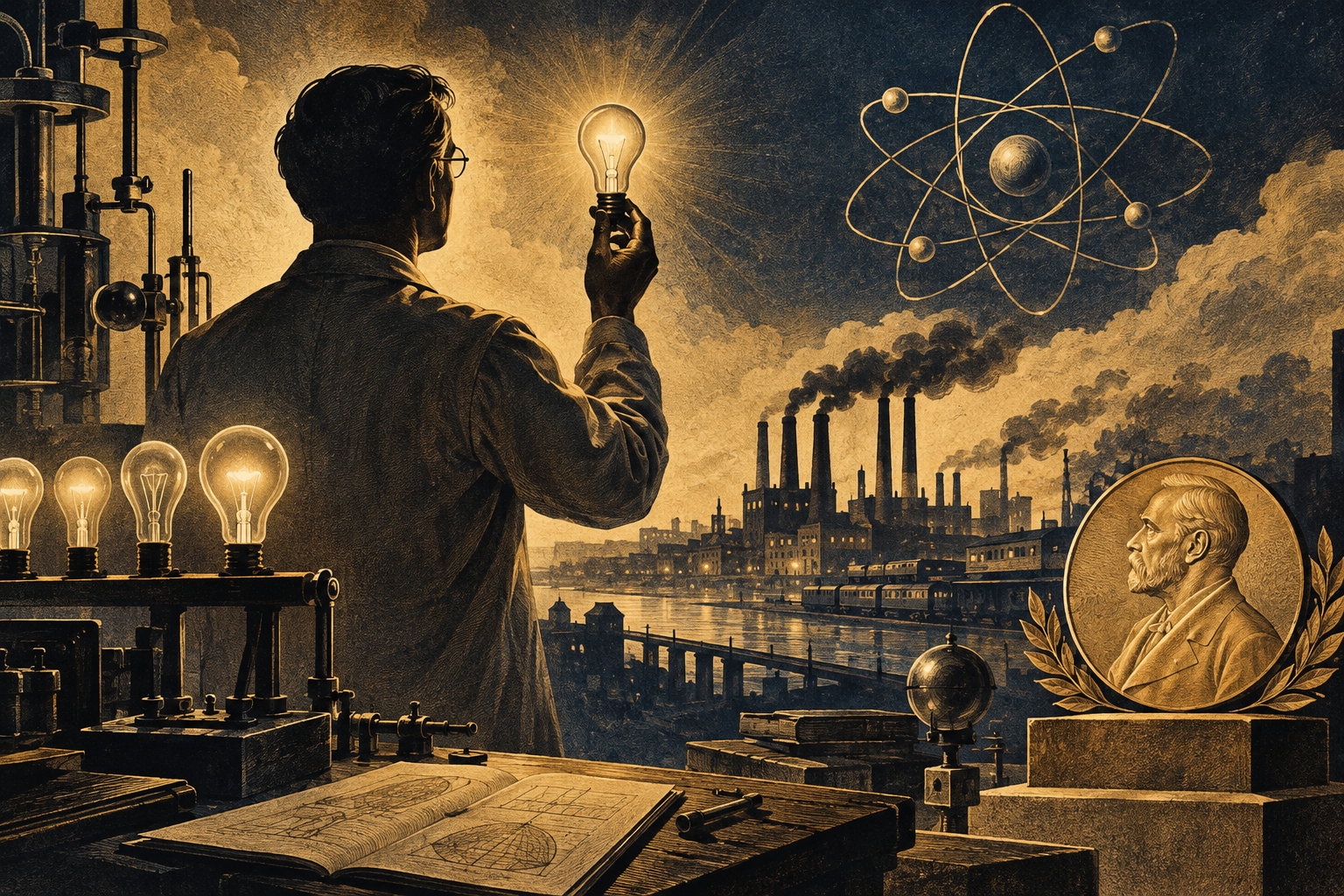
At GE, Langmuir’s first assignment concerned difficulties with tungsten-filament light bulbs. Rather than concentrating only on the finished lamp, he investigated its operating principles, including chemical reactions promoted by the hot filament. He proposed filling bulbs with nitrogen, and later argon, and winding the filament into a spiral to reduce tungsten vaporization. His investigations of filaments in gases also led to the discovery of atomic hydrogen. Langmuir subsequently put that discovery to practical use in developing atomic hydrogen welding, extending the reach of his lamp research into another industrial process.
Sourced history
A World One Molecule Thick
Surface chemistry—the study of chemical forces where different substances meet—became the work for which Langmuir received the 1932 Nobel Prize in Chemistry. He investigated adsorption, the attachment of atoms or molecules to a surface, and developed a theory involving layers only one molecule thick. His research included stable films on tungsten and platinum filaments and experiments with oil spread on water. In a 1917 paper, he described how certain oils could form a single-molecule layer on water. Knowing the oil’s volume and the area it covered allowed the film’s thickness to be determined, offering a way to investigate molecular arrangements.
Sourced history
Extending Ideas About Atoms
Langmuir’s interest in chemical reactions also drew him toward questions of atomic structure and valence. He contributed to the development of Gilbert Newton Lewis’s theory of shared electrons. In a 1919 paper, Langmuir expanded on Lewis’s ideas about bonding through shared electron pairs and introduced the concept of the covalent bond. His scientific work thus ranged from the behavior of lamp filaments to explanations of how atoms join together.
Sourced history
Research Shared with Blodgett
Katharine Burr Blodgett met Langmuir during a visit to GE near the end of her studies at Bryn Mawr College. He encouraged her to broaden her scientific education. After earning a master’s degree in physics at the University of Chicago, she joined him as a research assistant in 1918, becoming the GE research laboratory’s first woman scientist. Their collaboration included molecular films and electrical discharges in gases. After further study at Cambridge, Blodgett returned to GE. Their film research included building layers one molecule at a time; in 1939, Blodgett invented nonreflecting glass using a 44-molecule-thick coating of barium stearate.
Sources: [4]
Sourced history
Beyond the Laboratory Lamp
Langmuir’s later interests included atmospheric science and meteorology. During World War II, he helped improve naval sonar detection, while his work with Blodgett included protective smoke screens and aircraft-wing deicing methods. His association with GE continued until 1950. Away from research, he enjoyed mountaineering, skiing and flying. He died on August 16, 1957.
Commentary
Perspective: A Legacy of Following Questions
For GE Heritage Village, Langmuir’s career offers a compelling way to understand industrial research: a practical problem can become an invitation to ask deeper questions. His significance, in this view, lies not simply in a list of inventions or honors, but in the interplay between explanation and application. Remembering Blodgett alongside him also makes that legacy richer, emphasizing mentorship and collaboration rather than treating discovery as the achievement of an isolated individual.
Sources
- [1] Irving Langmuir - Wikipedia — en.wikipedia.org
- [2] Irving Langmuir – Biographical - NobelPrize.org — NobelPrize.org
- [3] Nobel Pursuits: Irving Langmuir’s Professional Scientific Journey Started at Stevens | Stevens Institute of Technology — Stevens Institute of Technology
- [4] Irving Langmuir and Katharine Burr Blodgett | Science History Institute — Science History Institute
Written in original words with AI help from the sources above and automatically checked against them. Facts, quotations and commentary are labeled separately; credit belongs to the original authors. GE Heritage Village is independent and not affiliated with GE or Crotonville.