
Sourced history
A lighting name with telephone roots
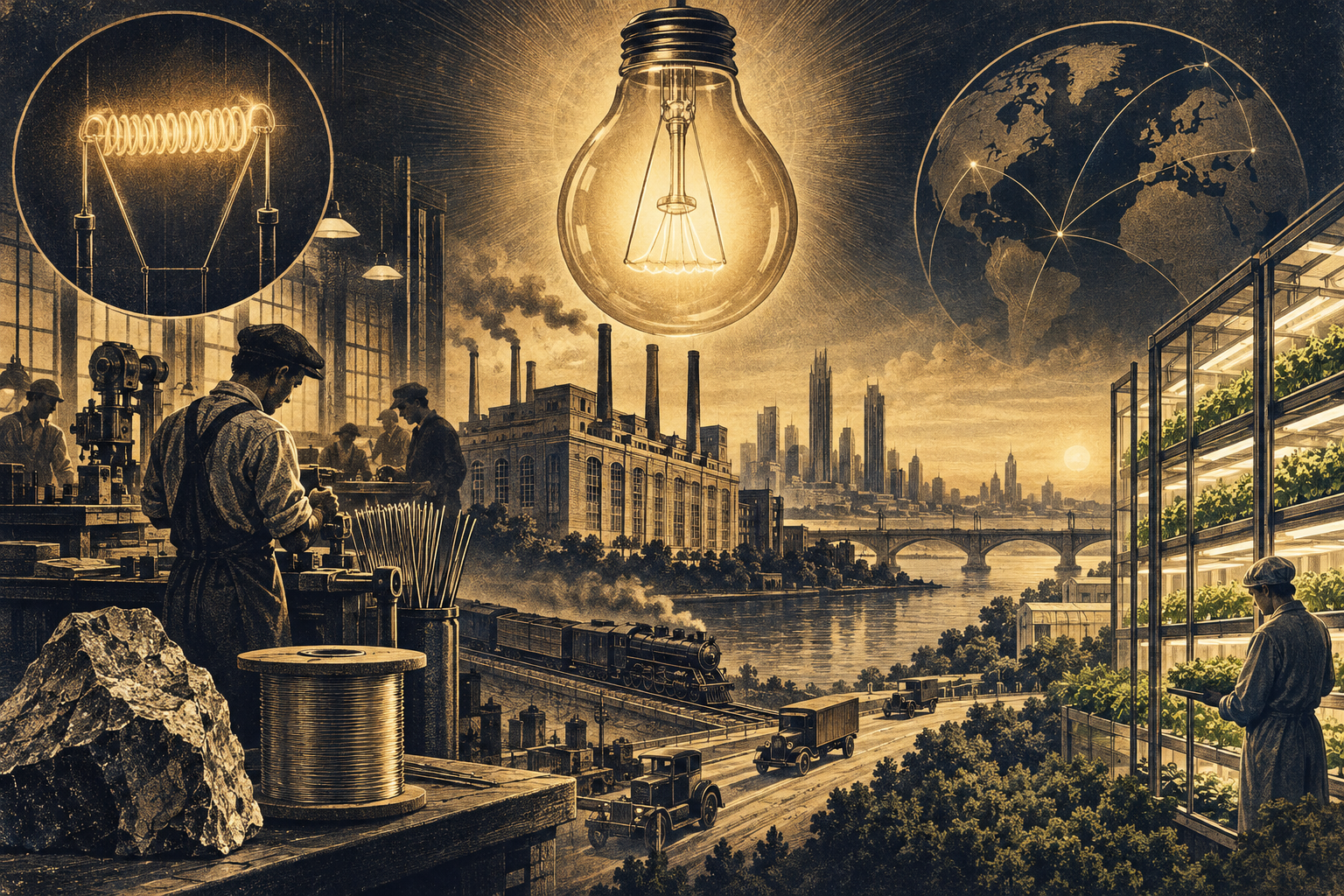
Tungsram began in Újpest, now part of Budapest, in 1896. Its first products were telephones, wires and switchboards, rather than the light bulbs for which it became known. The company’s name combined tungsten and wolfram, two names for the metal used in lamp filaments. On 13 December 1904, Sándor Just and Franjo Hanaman received Hungarian patent no. 34541 for a tungsten-filament bulb. Their design offered longer life and brighter light than a carbon filament. The inventors licensed the patent to the company that became Tungsram.
Sources: [1]
Sourced history
Beyond the bulb
During World War I, Tungsram began mass-producing radio tubes, which became its most profitable business division. Lighting research continued: in 1934, the company incorporated Imre Bródy’s patent for krypton-filled bulbs, extending lamp life. Television also entered the laboratory. In March 1937, experimental broadcasts transmitted still images of the Tungsram trademark and Mickey Mouse. By June, an experimental station at Újpest had successfully tested continuous moving-picture transmission using a charge-storage video camera developed by the company. Before nationalization by the Communist government in 1945, Tungsram ranked third worldwide in light-bulb and radio-tube manufacturing, behind General Electric and RCA.
Sources: [1]
Sourced history
The GE transformation
The supplied accounts differ on the acquisition date: Eurocenter’s retrospective places GE’s purchase in 1989, while Wikipedia and Food Autonomy date its acquisition of a majority stake to 1990. The latter two accounts describe a $600 million investment over six years and restructuring throughout Tungsram’s operations. Wikipedia identifies this as the largest manufacturing investment by a U.S. company in Central and Eastern Europe at the time. Tungsram subsequently operated as a General Electric subsidiary, with its historic name retained as a brand.
Sourced history
The name returns to the business
In February 2018, Jörg Bauer agreed to buy GE’s lighting business across Europe, the Middle East, Africa and Turkey, together with its worldwide automotive lighting business. Operations continued under the Tungsram Group name. Eurocenter’s April 2018 report described the Hungarian facilities passing to new ownership: the Budapest light-source factory, Nagykanizsa’s light-source factory and logistics centre, Kisvárda’s halogen and automotive lamp factory, and component factories at Zalaegerszeg and Hajdúböszörmény. Bauer presented the revived Tungsram as an innovation-based European brand with international ambitions.
Sourced history
Light becomes a research tool for food
Food Autonomy documents a 2021 vertical-farm installation at Tungsram’s Újpest headquarters in Budapest. Food Autonomy was then Tungsram’s Agritech business unit and supplied four- and six-channel research lighting modules. Five research farm units provided a combined production area of 150 square metres. Microgreens, strawberries, baby leaves and salads grew hydroponically under artificial LED light, independent of daylight or weather. Two smaller growth chambers supported initial research before successful growing recipes moved into the commercial-sized facility. Powergrow software monitored and remotely controlled daily operations. Although commercial in scale, the farm’s emphasis was research and development.
Sources: [3]
Sourced history
A difficult final chapter
In April 2022, Tungsram laid off 1,600 employees. It sought bankruptcy protection in May. In November, as the six-month protection period approached its end, the company announced that it had failed to reach an agreement with creditors and would enter liquidation.
Sources: [1]
Commentary
Historical perspective: more than an acquisition
For GE Heritage Village, Tungsram’s significance lies in the meeting of industrial histories, not simply a change of ownership. Its story invites us to view GE’s legacy through the identities and expertise of businesses that joined it. In my view, preserving that distinction makes the history richer: technical ingenuity, corporate investment and commercial survival deserve attention together, without treating innovation as a guarantee of permanence.
Sources
- [1] Tungsram - Wikipedia — en.wikipedia.org
- [2] "Our Heritage is Innovation" - Tungsram Returns to Hungary — eurocenter.hu
- [3] Tungsram – Food Autonomy Lighting – Horticulture, Floriculture, Vertical Farming — Food Autonomy Lighting - Horticulture, Floriculture, Vertical Farming
Written in original words with AI help from the sources above and automatically checked against them. Facts, quotations and commentary are labeled separately; credit belongs to the original authors. GE Heritage Village is independent and not affiliated with GE or Crotonville.